From Rider Feedback to a Racing Machine
The On&On Race was conceived from direct rider feedback. Gravel racing is no longer a niche discipline; it has become one of the most exciting and rapidly evolving areas in cycling, capturing the attention of both professionals and passionate amateurs alike. The UCI Gravel World Series has expanded rapidly in recent years, growing from 10 events in 2022 to 33 in the 2024–25 season, underscoring the seriousness of the discipline.
Our Spectra Pearson team riders and brand ambassadors had already delivered strong results on the On&On Adventure. That model proved its mettle, with consistent performance and even a national Cyclocross title in the 2024–2025 season. It was clear the Adventure had the versatility and durability required for top-level cyclocross and gravel racing.
Yet, inside that success was a more ambitious request. The riders told us: “We want more race focus. We want lighter weight, sharper handling, and a frame optimised for performance under pressure.” The Adventure was built for adaptability. It could carry luggage, endure multiday excursions, and handle rough, mixed terrain. But the feedback made one thing clear. What riders wanted now was not a Swiss Army Knife. They wanted a scalpel.
The combined voices of our team riders and ambassadors set us a challenge: to build the fastest and lightest gravel bike we have ever produced.

The Role of Carbon Layup
The On&On Adventure uses a T800 carbon layup. This grade offers excellent strength, durability, and relatively low weight, making it ideal for a bike built to handle bikepacking and demanding gravel riding. T800 has long been trusted across high-performance road and gravel frames because it strikes the right balance between toughness and weight savings. It can absorb the knocks that come with off-road use, while still delivering a lively, responsive ride.
For the Race version, we stepped up to Toray T1000 high-strength carbon combined with selected plies of Toray MJ-series high-modulus fibre. T1000 has a significantly higher tensile strength than T800. In practice, this allows us to use fewer layers without sacrificing structural integrity, resulting in a lighter frame with sharper acceleration and a more immediate pedalling response. The MJ-series fibres add targeted stiffness in key areas such as torsion and bending resistance, enhancing energy transfer and giving the frame its race-tuned feel. Because high-modulus fibres can be less impact-tolerant, their use is carefully controlled within the layup to maintain durability in real-world riding.
It’s important to note that materials alone don’t define performance. Carbon fibre is only as effective as the layup design behind it. Fibres aligned at 0° maximise stiffness under pedalling loads; ±45° fibres resist torsional twisting in corners; and 90° fibres provide vertical impact resistance. By carefully adjusting the number of layers, their thickness, and fibre orientation, we can dictate how the frame reacts under different forces.
This precision enables us to build frames that feel efficient and direct under hard acceleration, yet remain compliant enough to avoid harshness or fatigue over long gravel races. The On&On Race is the result of that philosophy: our very best materials combined with a layup architecture designed explicitly for speed.
Finally, the Race frame has been stripped of non-essential mounting points and bosses. On the Adventure model, these fixtures are vital for racks, guards, and additional bottles on long-distance trips. But on a race platform, every extra fitting adds weight and disrupts the clean aerodynamic lines. By removing them, we reduced overall mass and created a sleek, uncluttered profile that cuts through the air more efficiently while underlining the frame’s single-minded purpose.
Toray Technical Data (Torayca® Carbon Fibers):
- T800S: Tensile Strength ~5.5 GPa, Tensile Modulus ~294 GPa
- T1000G: Tensile Strength ~7.0 GPa, Tensile Modulus ~294 GPa
(Source: Torayca® Technical Data Sheets)

The Testing Process
Developing a racing platform requires far more than simply choosing a higher grade of carbon. The process is iterative, with prototypes created, each one refined through careful analysis of the layup and real-world testing.
Internal testing is always the first step. Everyone at Pearson rides, and our in-house riders include former professionals, engineers and highly experienced amateurs. This gives us a broad spectrum of feedback. Prototypes are tested in all conditions, from long winter training rides to short, sharp efforts where weaknesses are quickly exposed. Issues such as unwanted flex at the bottom bracket, excessive harshness on rough surfaces or small handling quirks are identified and corrected at this stage.
Once we were confident in the platform, team and ambassador testing began. Team Spectra and our brand ambassadors put early versions of the On&On Race into real competition. Racing provides the most demanding test environment, where frames are pushed to their limits under pressure. The feedback from riders like Lizi Brooke and the wider team was invaluable in fine-tuning details such as head tube stiffness, vibration damping, and overall ride feel. Their insights guided adjustments to layup until the bike delivered exactly what they were asking for.

The Result
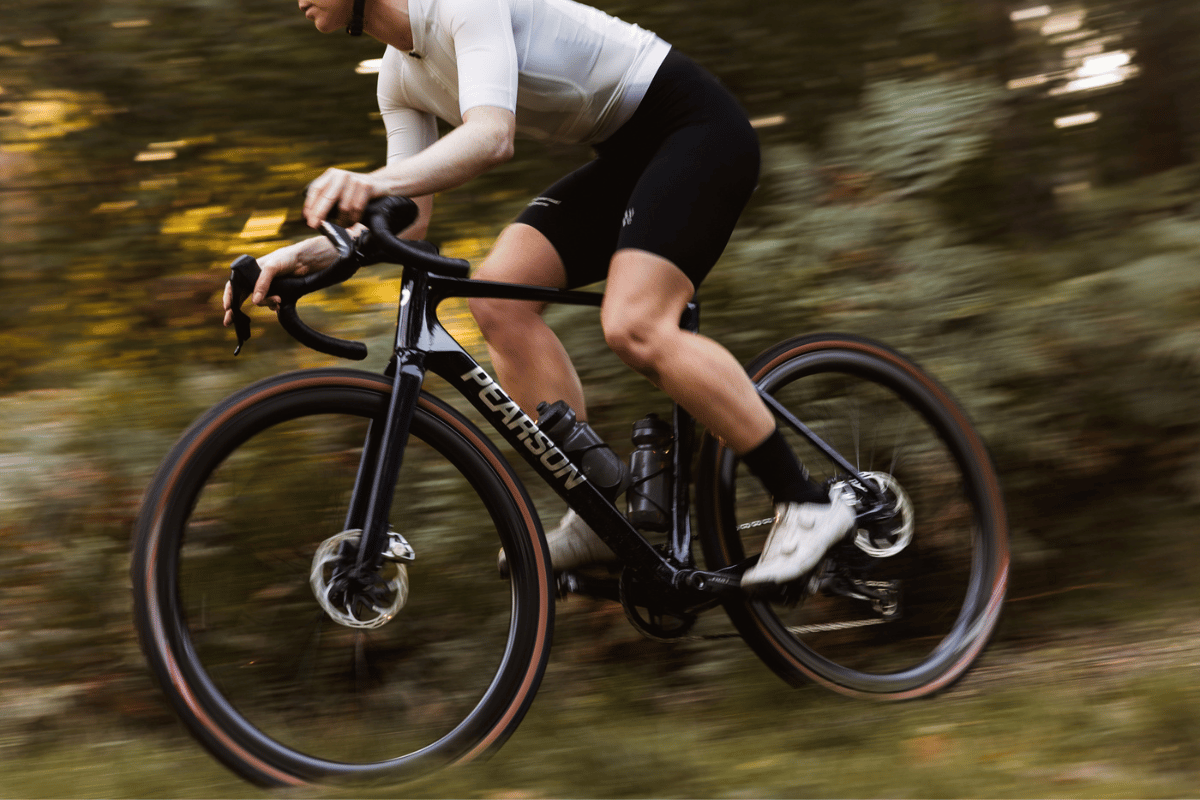
The result is the lightest gravel bike Pearson has ever built in more than 165 years of frame design. A size 3 build with SRAM Red weighs 7.88 kilograms in the Dawn Blue colourway. Compared with the On&On Adventure, the new Race frame is around 20 percent lighter. In the context of high-performance bike design, where gains are often measured in fractions of a percent, this represents a major leap forward in development. That weight saving translates directly into sharper climbing performance, faster acceleration and greater efficiency over long distances.
This also positions the On&On Race among the lightest gravel racing bikes on the market. For context, the Pinarello Dogma GR claims a complete weight of around 7.35 kilograms, while other leading ultralight builds fall in the 7 to 8 kilogram range. Many mainstream gravel platforms remain significantly heavier, typically between 8.5 and 9.5 kilograms. The On & On Race delivers performance that can compete directly with the very best, while achieving a remarkable step forward from within our own range.
All Out, Anywhere
The On&On Race is designed to be fast on every type of surface. It is stripped back, highly efficient and ready to perform in competition. What started as feedback from riders has become the fastest and lightest gravel bike we have ever produced. It is a machine with one clear purpose: to win.
Explore the ON&ON RACE