Endurance vs aero road bike: how to choose
Endurance vs aero road bike comes down to one question: are you riding to go far in comfort, or to go fast and win? An endurance bike like Forge is built for all-day speed and stability. An aero bike like Shift 2.0 is built to slice through the air when the pace lifts. The right answer is the one that matches how you actually ride.

The honest split between the two
Both bikes are fast carbon road machines, so this is not slow versus quick. It is a difference of priority. An endurance bike is engineered around the rider who covers big distances, often on imperfect roads, and wants to finish strong rather than empty. An aero bike is engineered around the rider who wants every watt to go further, especially at the speeds where wind resistance dominates.
Forge is the performance endurance bike: fast and far. Shift 2.0 is the aero race bike: made to win. Once you know which of those sentences describes your riding, most of the decision is made.
Geometry and position
The clearest difference is how the two bikes put you on the bike. An endurance bike runs a taller head tube and a slightly shorter reach, which lifts the bars and brings the hoods closer. That position is easier to hold for hours, kinder to your back and neck, and more stable when you are tired. It does not make you slow, it makes you sustainable.
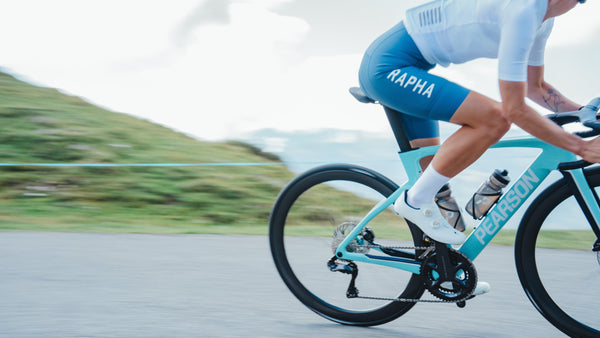
An aero bike is lower and longer at the front. Shift 2.0 in size 3 runs a 547mm stack and 384mm reach, with a 74 degree seat angle and a 73 degree head tube angle. That puts you in a flatter, more committed position that reduces frontal area and helps you hold speed. It rewards riders with the flexibility and core strength to stay there, and it asks more of riders who do not.
This is exactly why fit matters more than any geometry chart. The numbers tell you the shape of the bike, but your body decides whether that shape works. A professional fit will tell you whether you can comfortably hold an aero position or whether an endurance front end will serve you better over a season.
Ride feel
Forge feels planted and composed. It carries speed well, settles on a descent and stays calm when the surface turns rough. That comes partly from geometry and partly from a frame tuned to take the sting out of long days without feeling vague. It is the bike you want at mile 90 of a hilly sportive.

Shift 2.0 feels sharp and eager. It is 20 per cent lighter than the 2024 model, built from a T1000 and M40JB carbon layup with a T800 and M40JB fork, and its CFD-modelled aero profiles were tested at the Silverstone Sports Engineering Hub. The one-piece cockpit tidies the front end for both stiffness and airflow. It is ISO 4210 tested and UCI approved, so it is built for racing as well as fast group riding. On the road it feels like a bike that wants to be pushed.
Tyre clearance
Endurance bikes generally clear wider tyres, and that clearance is a deliberate comfort and capability choice. Forge takes tyres wide enough to handle packed gravel, rough chip-seal and broken British lanes without drama, which matters if your roads are not billiard-table smooth.
Aero bikes prioritise tight, fast tube-to-tyre integration. Shift 2.0 is happiest on quality road rubber at race pressures, where its aero shaping does its work. If your local roads are rough and you value running bigger tyres, that points towards Forge.

Who each bike suits
| Consideration | Forge (endurance) | Shift 2.0 (aero) |
|---|---|---|
| Best for | Sportives, long days, mixed roads | Racing, fast group rides, flat-out efforts |
| Position | Taller, more relaxed | Lower, more committed |
| Priority | Comfort and stability over distance | Speed and drag reduction |
| Tyre clearance | Wider, more forgiving | Tighter, road-focused |
| Frameset price | from £2850 | from £3100 |
Choose Forge if you ride to go far in comfort, if your roads are rough, or if a lower aero position would leave you sore before the end of a long ride. Choose Shift 2.0 if you race or ride fast, if you have the flexibility to hold a low position, and if shaving time off your efforts genuinely matters to you.
Price
Forge frameset starts from £2850, with complete build pricing shown on the product page. Shift 2.0 frameset starts from £3100, and complete builds start from £5450. Both can be bought as a frameset to build to your own taste or as a complete bike specced by the Pearson team. DivideBuy 0 per cent finance is available up to 36 months, and all Cycle to Work schemes are accepted.
The shared fit-led build
Whichever you choose, the build process is the same, and it is the part that often matters most. Pearson frame geometry is informed by 2,000+ professional bike fits collected over 13 years, so the sizing logic behind both bikes is grounded in real riders rather than a spec sheet. Fit data sets your frame size, and contact points such as bar width, stem length, spacers, crank length and saddle setback are dialled in at build.
The frames are designed in London, and every bike is built, specced and tested by the Pearson team there before it ships. UK mainland bikes arrive hand-delivered, built and ready to ride. Pearson does not run fits in-house, but offers up to £200 cashback on a professional bike fit with any fitter, claimed after delivery, so you can have your fit done locally and bring the data to the build.
Frequently asked questions
What is the difference between an endurance and an aero road bike?
An endurance road bike prioritises comfort and all-day stability with a taller front end and wider tyre clearance. An aero road bike prioritises speed with a lower, more stretched position and tube shapes designed to cut drag. Forge is the endurance bike, Shift 2.0 is the aero bike.
Is an aero road bike worth it for most riders?
If you race, ride fast group rides or chase times, the aero gains of Shift 2.0 are real and measurable at speed. If your riding is sportives, long weekend miles and mixed-quality roads, an endurance bike like Forge will usually be the more comfortable and more useful choice.
How much do Forge and Shift 2.0 cost?
Forge starts as a frameset from £2850, with complete build pricing shown on the product page. Shift 2.0 starts as a frameset from £3100, with complete builds from £5450. Both are built, specced and tested by the Pearson team in London.
Which is more comfortable, Forge or Shift 2.0?
Forge is the more comfortable bike over long days, with a more relaxed position and wider tyre clearance to take the edge off rough roads. Shift 2.0 is comfortable for an aero bike, but its lower, faster position asks more of your flexibility and core.
Decide whether you are riding to go far or to go fast, then match the bike to the answer. Explore Forge and Shift 2.0 and pick the one that fits how you actually ride.